Express the intended outcome
Describe requirements, scenarios, constraints, decisions and acceptance criteria. Turn an agreed scope into intent that can be inspected and handed off.
Saga GAME / Generate · Attribute · Measure · Evidence
Screen an opportunity and agree its scope with GAME Pipeline. Express the intent and acceptance criteria in GAME Spec. Organize work and attribution with GAME Plan. Retain activity and provenance through GAME Events—across people, agents and organizations.
Explore each product’s responsibility and current availability below.
GAME Pipeline / opportunities, scope and agreements
The product workflow develops work opportunities—not just inbound leads—through screening, scope, proposals and agreements. Current local intake/review supports qualification and reviewed opportunity creation. The broader screening, scoping, agreement and delivery-handoff workflow below is planned scope; it is not a claim of a complete live system.
Screen the opportunity: assess fit, capability, capacity, constraints and risks across client work, partnerships, consulting, employment and internal initiatives. Advance, defer or decline with a reason and responsible owner.
Shape the scope: define objectives, deliverables, boundaries, assumptions, responsibilities and acceptance criteria. Draft planning can help test feasibility before commitment.
Prepare the proposal: connect the exact scope to the applicable terms, timing, dependencies and commercial expectations.
Record the agreement: confirm approval of the scope and terms by the responsible parties. External delivery needs the applicable client agreement; internal work needs an approved brief.
Hand off the approved scope: express delivery intent and acceptance criteria in GAME Spec, then connect them to GAME Plan. Preserve agreement, opportunity and referral context; changes return for review before authorized delivery is updated.
GAME Spec / intent and acceptance
GAME Spec is the portable specification of intent: what should be delivered, why it matters, the constraints it must respect and the evidence needed for review. Give people and agents a shared, versioned reference before organizing or executing the work. The current package supports local specification and plan checks; network-host integration and acceptance remain separate gates.
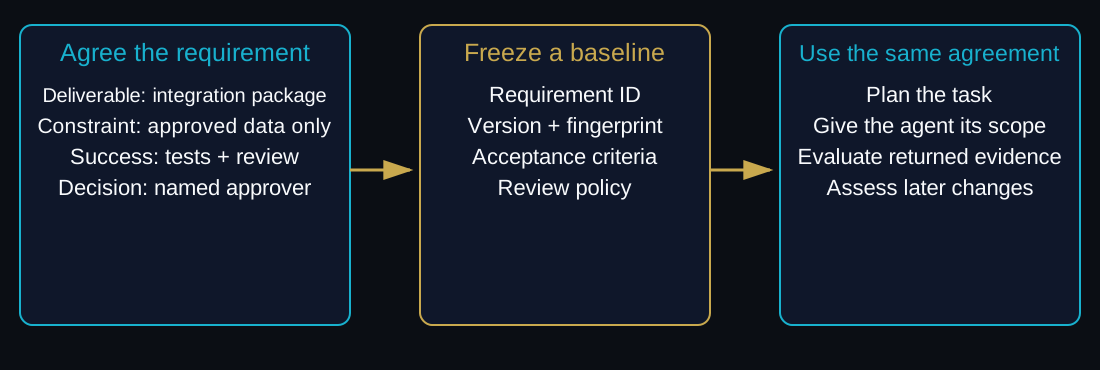
Describe requirements, scenarios, constraints, decisions and acceptance criteria. Turn an agreed scope into intent that can be inspected and handed off.
Identify the specification revision and baseline fingerprint. Connect contributions and evidence to the exact intent they address.
Generate a starting plan for new work or reconcile requirements with an existing plan. GAME Plan retains dependencies, roles, living status and completion gates.
Featured product / GAME Plan
Connect contributions to owners, priorities, dependencies and completion evidence. Use an authorized host to inspect the assignment board and coordinate delivery.
Connect each contribution to the intent, requirement and acceptance criteria defined in GAME Spec.
Define accountable owners, contributor roles, priorities and review responsibilities. Make intended participation visible before work begins.
Use the assignment board to identify ready, unassigned and blocked work, along with the prerequisites needed to proceed.
Keep status, notes, outputs and verification records together through checked plan updates. Recorded progress and submitted evidence are distinct from accepted completion.
Review the evidence required by the task before closing it. Exact criteria and verification bindings depend on the supported package and owning host; the agent cannot silently accept its own result.
Export contribution and evidence relationships for the receiving attribution process. Plan supports attribution review; it does not calculate rewards or authorize payment.
GAME Plan / Requirements and evidence
When intent changes in GAME Spec, review the affected GAME Plan contributions and evidence against the revised baseline. Current change-impact tooling reports from explicit snapshots; applying changes and accepting evidence require the responsible host and reviewers.
When intent changes, identify affected contributions, dependencies and evidence that needs renewed review.
Keep earlier proof and its original baseline intact; do not silently rebind it to new requirements.
The current change-impact feature proposes review notes from exact snapshots. Applying changes and accepting evidence remain separately authorized.
GAME Events / activity, transitions and reviewed completion
The deployed capture core supports the first two steps below. Work-lifecycle and final-acceptance integration remain planned.
Current capture: record permitted interest and referral/campaign context with retry-safe event receipts.
Current request notification: save a network request first, notify the admin mailbox once for a new receipt, and retain the request if email fails.
Planned work lifecycle: preserve authorized assignment, start, progress and blocked transitions from Plan and its execution host.
Planned completion review: record submission, changes requested, rejection or acceptance with the authorized reviewer and exact evidence context. Events records the decision; the owning process decides it.
Illustrative integration project: a partner introduces an organization that needs a new service. It combines current capabilities with planned handoffs; it is not a live deployment.
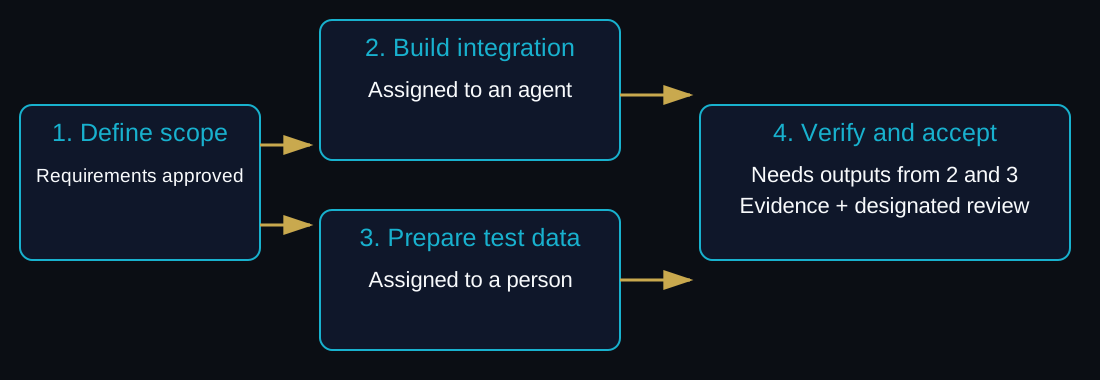
Pipeline screens the opportunity and, in its expanded workflow, develops an approved scope: the integration, permitted data, deliverables and acceptance criteria.
Define the integration requirements, constraints and acceptance criteria against a versioned baseline before assigning delivery work.
Plan separates agent implementation from human test preparation. Review waits for both outputs; the designated reviewer owns acceptance.
Events preserves permitted referral and source context. Its planned lifecycle extension connects that record to progress and completion review.
The reviewer assesses the outputs and checks against agreed criteria. Retained referral and contribution evidence can support shared network rewards under applicable terms; it does not automatically grant credit or payment.
GAME Plan / Execution handoff
Optional integration preview: select ready work from GAME Plan, authorize a bounded Saga Agent task and return its work record and checks for review. GAME Plan retains the contribution context and completion gate. A finished Agent run does not automatically complete the contribution.
Community membership is free and includes Saga Oracle at Validator. Saga GAME product/package prices and the all-three bundle are being finalized. GitLab access is coming soon; designated builder access requires a qualifying subscription, signed applicable license agreement and verified network/product authorization. AI remains BYOK.
Our home network for builders, early adoption and contributions to the tools.
Join the SagaHalla builder pathThe first external licensed network, for scoped engagements and regulated workflows.
Explore the Aregis path